Three-Year-Old's Terrifying Encounter: Thrown into Crocodile Pit
The incident happened at the family zoo attraction in Huntingdonshire (Picture: Johnsons of Old Hurst)
A young boy was seriously injured after he is said to have been thrown into the crocodile enclosure at a family zoo.
The incident happened at Johnsons of Old Hurst zoo north of St Ives in Huntingdonshire today.
Alarm was raised at about 1.24pm after reports that a three-year-old boy had ended up in the crocodile pen.
He was rescued from the animals and taken to Addenbrooke’s Hospital with serious injuries.
He remains in a critical but stable condition.
The zoo’s social media says it is passionate about crocodiles and they are ‘at the very core of our history’ (Picture: Johnsons of Old Hurs)
Now a 30-year-old man from Norfolk has been arrested on suspicion of attempted murder, and detectives from the major crime unit are investigating the incident.
Det Insp Verity McCann said: ‘At this stage we are speaking to people who were at the zoo at the time of this distressing incident to understand more about the circumstances.
‘We do not believe the man arrested and the child are known to each other.
‘Officers are supporting the boy’s family at hospital, and our thoughts remain with them.’
Where did the incident happen?
The emergency services were called to the family-owned farm on Church Street, Huntingdon, which is led by Andy Johnson, a fourth-generation farmer.
It started as a dairy farm before expanding into the current attraction featuring a butcher’s, farm shop, a tea room, a steakhouse and the zoo.
The farm website says the family has a ‘particular fascination with crocodiles’ and they have been involved with the animals for 20 years, including Mr Johnson’s involvement with crocodile farming research.
Mr Johnson made headlines in 2023 when he was given legal permission to cull deer to feed to his lions.
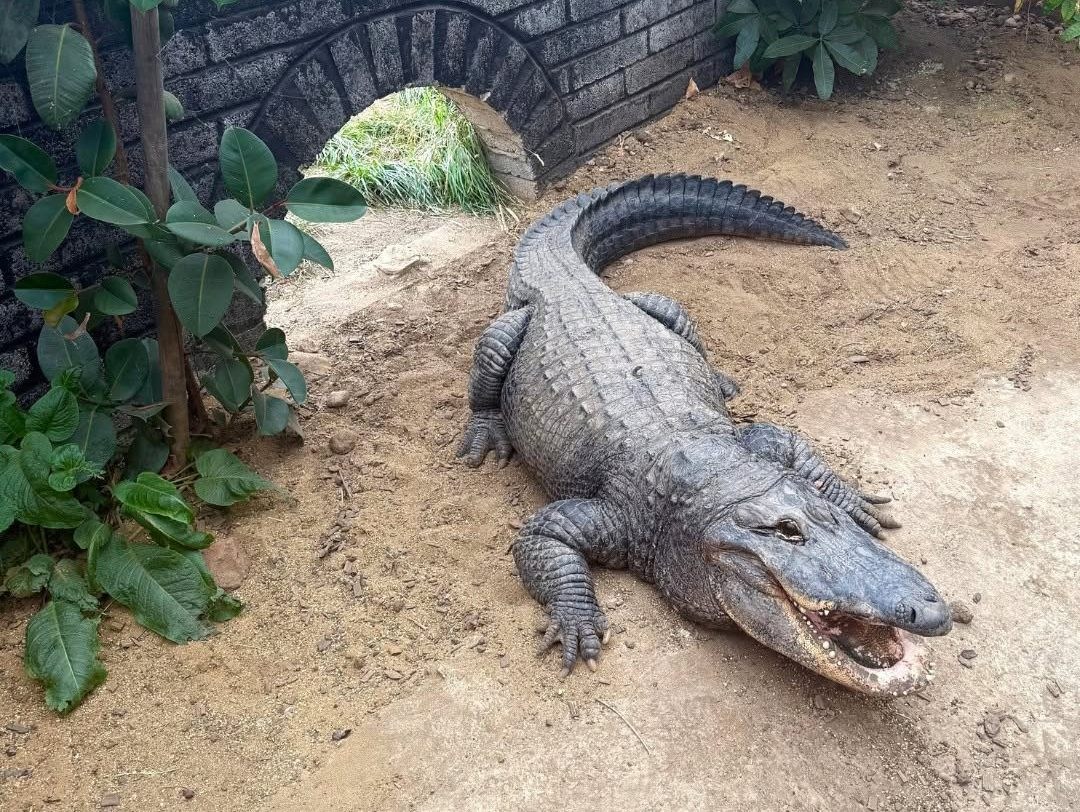
Johnson’s zoo houses several crocodilians along with big cats like lions and tigers, and bears and other exotic animals.
The farm includes crocodiles, alligators and caimans, and the largest crocs are two Nile crocodiles called Romeo and Cuddles.
The species or number of crocodiles involved in today’s incident has not been publicly revealed.
Saltwater crocodiles, or salties, are the largest of crocodilians, and they can grow to over 19 feet.
They are known to specifically target humans for food in areas where they live in the wild, and they have one of the strongest bite forces of any living animal.
The zoo marked the International Crocodile Day yesterday with a post on social media.
It said: ‘Crocodilians are at the very core of our history, our passion and the journey that has shaped Johnsons Zoological Gardens into what it is today.
‘These incredible animals have inspired generations of our family and continue to fascinate visitors from all over the country.’
Metro has approached Johnsons of Old Hurst for a comment.
Crocodile facts Crocodilians are found in the wild across tropical climates in Africa, Asia, the Americas and Australia. Saltwater crocodiles can grow the largest, and they can also live the longest, up to around 70 years. Their cells don’t age in a standard biological way like humans, and an elderly croc man be as energetic as a young one. Crocs can swim extremely fast underwater thanks to their powerful tail, which allows them to propel at a prey during an ambush. Crocodiles are known to stalk their victims and learn their behaviour patterns, and they use ambush to target prey. In the wild, the water’s edge is the croc’s number one kill zone, and even a large croc can hide in seemingly shallow water. Salties can stay submerged two hours on average, and up to eight hours in optimal conditions, as they can slow their heart rate to just 2-3 beats per minute. The reptilians have a famously foul breath described as that of raw sewage and rotting meat due to their diet of carcasses and scavenging. Their stomachs are highly acidic to break down large chunks of meat and bone, and food particles become lodged in their teeth, contributing to the smell of death.
Were you at Johnsons zoo when the incident happened? Please contact webnews@metro.co.uk
Got a story? Get in touch with our news team by emailing us at webnews@metro.co.uk. Or you can submit your videos and pictures here.
For more stories like this, check our news page.
Follow Metro.co.uk on Twitter and Facebook for the latest news updates. You can now also get Metro.co.uk articles sent straight to your device. Sign up for our daily push alerts here.